

Arashiyama 嵐山 and its Sagano Bamboo Grove 嵯峨野 竹林 is one of Kyoto’s most beloved sightseeing spots.
In this two-part series, we share an alternative walking route through Arashiyama along the ancient Atago-Kaido pilgrimage road (愛宕古道). By following this path, you will explore several remarkable temples before reaching the famous Sagano Bamboo Grove from a less-traveled direction. You will avoid the crowds and experience this iconic Kyoto destination in peace.
Enjoy a tune while browsing.
Click on any photo to view a larger version.
Map 1
Red line: Bus route from Randen Arashiyama Station (and Hankyu Arashiyama Station across the river) to the starting point of the walk.
Blue line: Latter portion of the walking route through the Sagano Bamboo Forest (detailed in Part 2 of this post).

From central Kyoto, there are two options to go to Arashiyama 嵐山. Option one: take the Randen Arashiyama line from Shijō-Ōmiya 四条大宮. Get off at the end of the line which is the Randen Arashiyama Station 嵐電嵐山駅 (see Map 2, do not confuse it with the JR station).
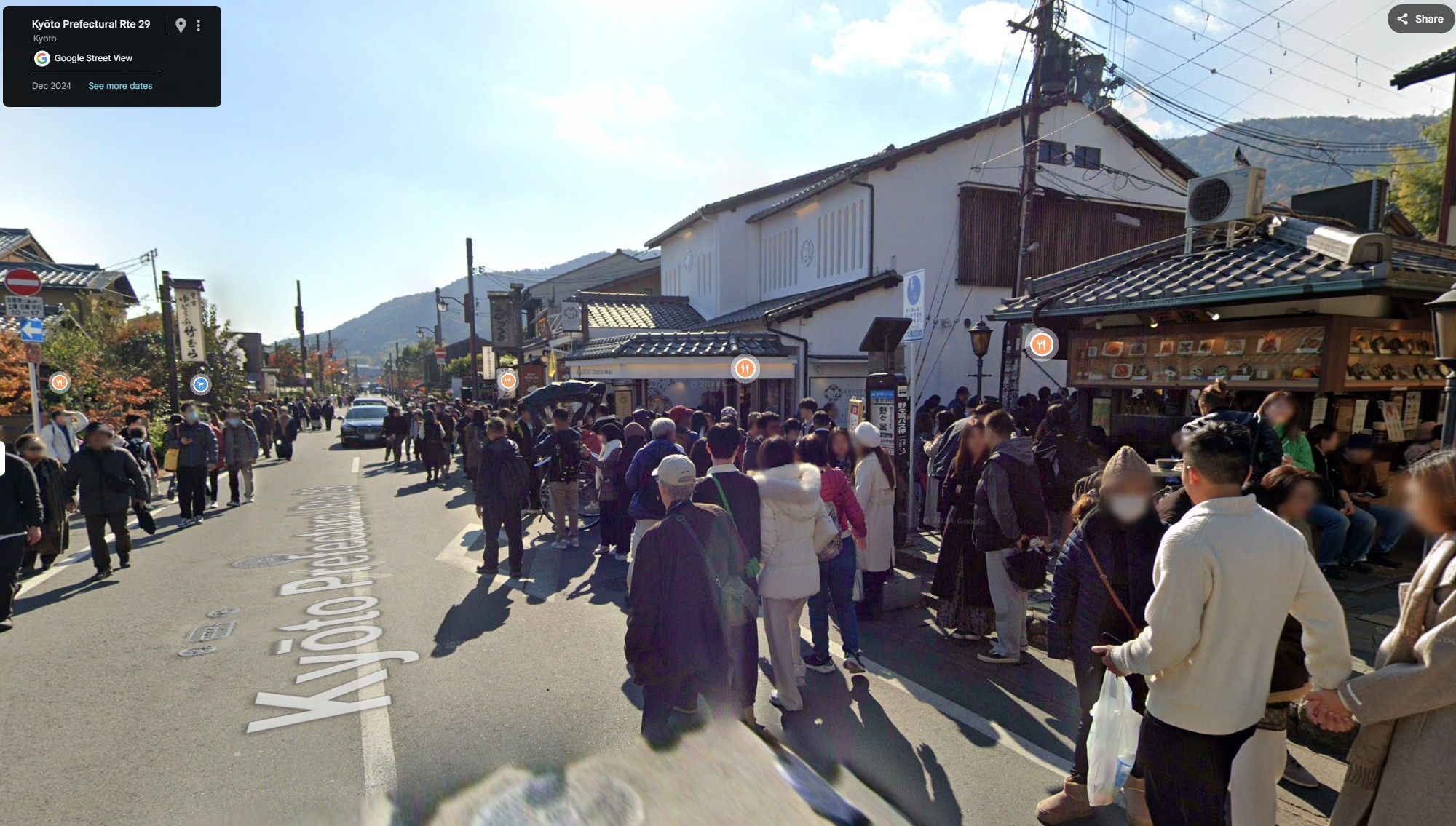
The main street just outside the train station has become overwhelmingly crowded with tourists and souvenir shops. Most visitors heading to the bamboo grove either walk directly through the grounds of Tenryu-ji (天龍寺)—a UNESCO World Heritage site—or take a side street further north that passes by Nonomiya Shrine (野宮神社).
Instead, take Bus No. 92 or 94 from the stop (阪急嵐山駅前(嵯峨釈迦堂前)) to the left of Tenryū-ji’s entrance on the main street. These buses originate from Hankyu Arashiyama Station 阪急嵐山駅 (not shown in Map 2) on the opposite side of the Katsura River, across Togetsukyō Bridge 渡月橋. Using the Hankyu Arashiyama Station is a second option if you’re situated in central Kyoto around Shijo-Kawaramachi 四条河原町.
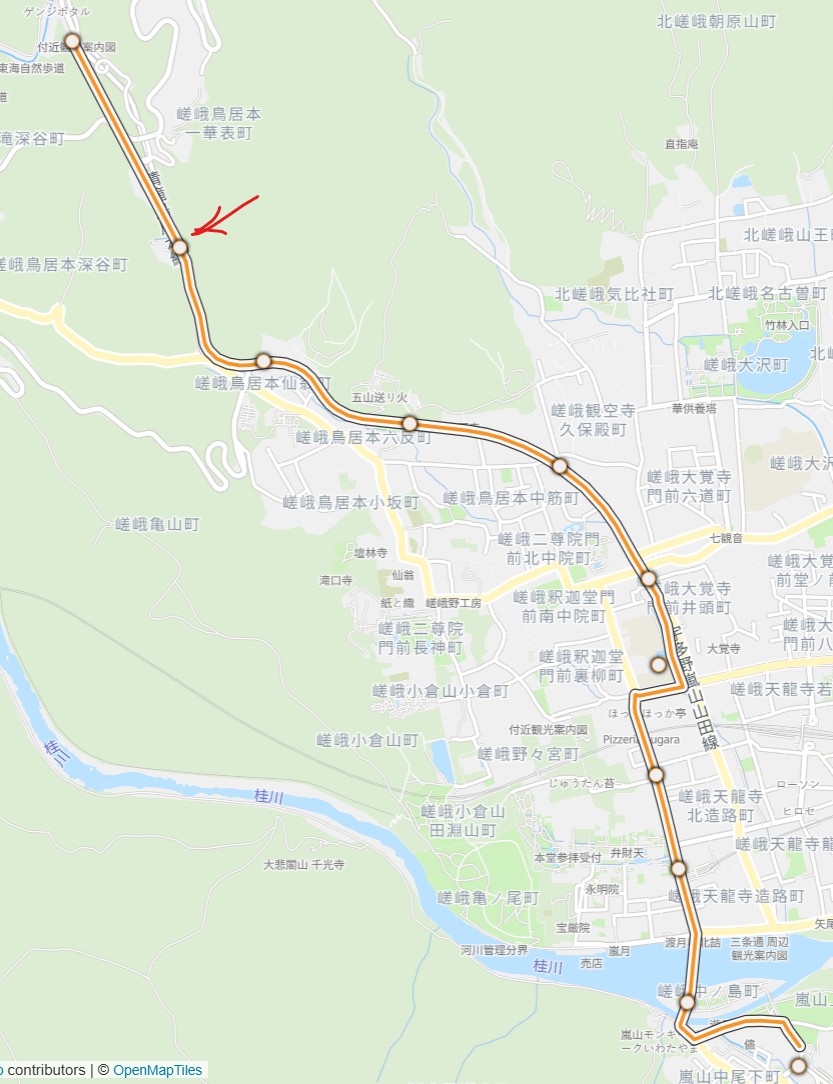
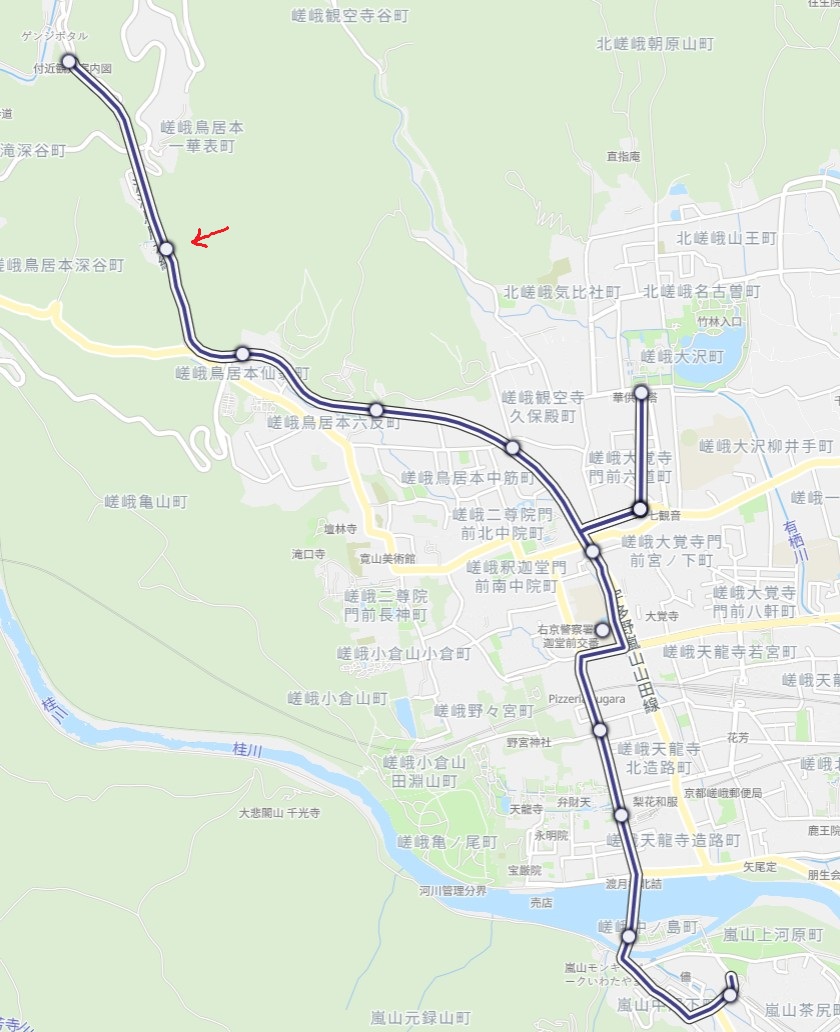
Note that the buses run only once every 30 or 60 minutes.
No. 94 makes a detour to Daikaku-ji Temple 大覚寺 along the way, so be sure not to disembark there by mistake.
Click on the map to see a larger version.
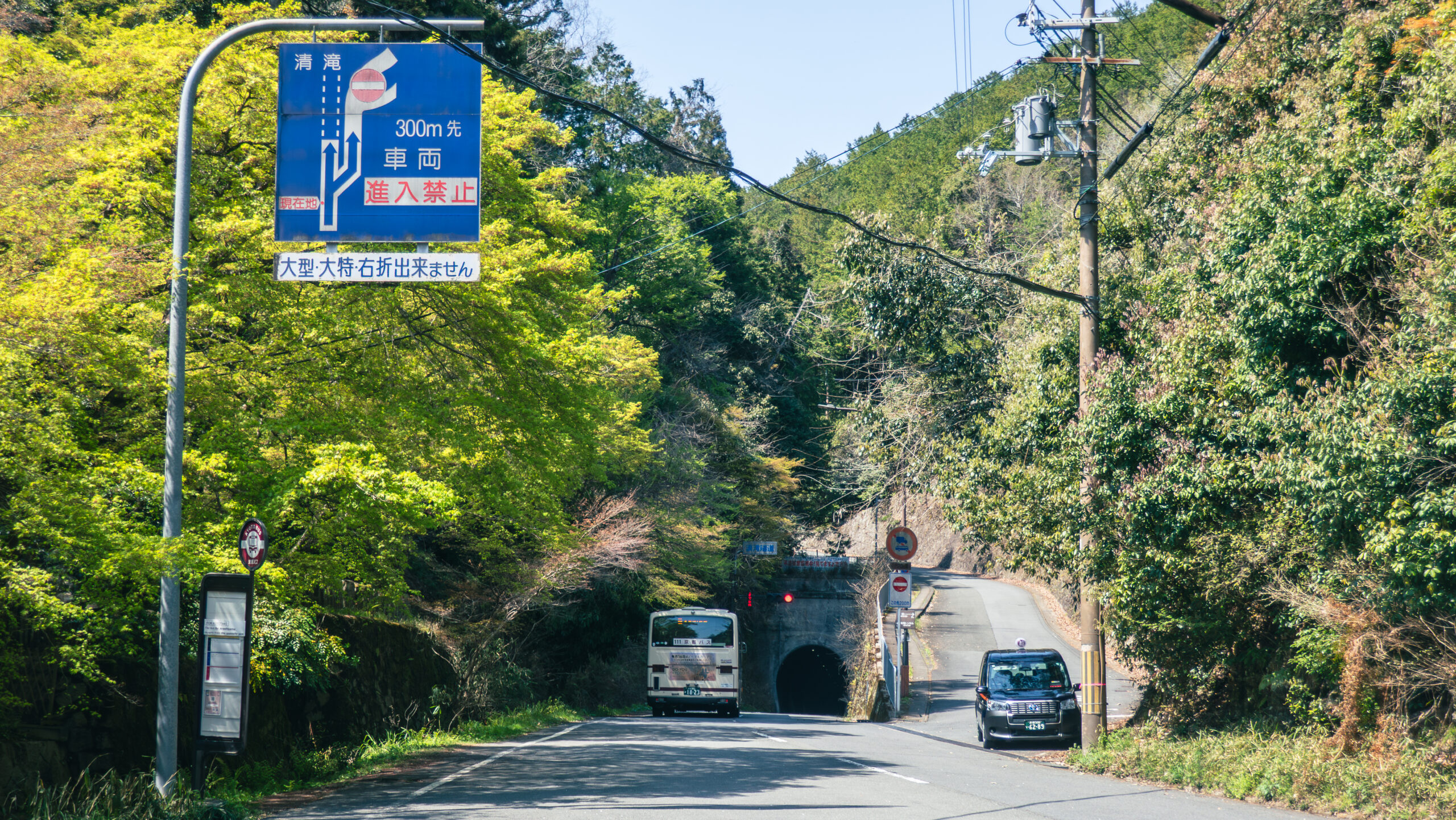
The bus ride takes approximately 20 minutes, depending on traffic. Disembark at Otagidera-mae 愛宕寺前 (red arrows in bus map), located just before a tunnel that leads toward Kiyotaki 清滝 (see top left corner of Map 2 for start of walk). When you can see the tunnel, get off the bus at the stop.
Map 2
Red indicates bus route from center of Arashiyama to the start of the walk
Blue indicates walking route from start to Adashino Nenbutsu-ji and then to Nison-In

Many visitors on the bus come here specifically to see the remarkable stone statues at Otagi Nenbutsu-ji temple 愛宕念仏寺, which is well worth a visit. It is most famous for its collection of moss-covered statues (carved in 1980’s) that represent the disciples of the historical Buddha.
But we are not stopping here.


Start the walk by following the narrow side street (Route 137) as it slopes gently downhill, heading back in the direction of the bus route. The path passes under an elevated expressway and soon joins Route 50. This junction is clearly marked by the First Torii Gate of Atago Shrine (愛宕神社 一の鳥居).
Walk downhill along this paved path, enjoying views of traditional homes (machiya, 町屋)—many with mossy thatched roofs (kayabuki 茅葺)—that line what was once a pilgrimage route, the ancient Atago-Kaido road 愛宕古道. Here is a historic Japanese teahouse featuring a thatched roof, hanging curtains, and outdoor red-cushioned benches inviting pedestrians to pause.


This 600-meter section showcasing architectural styles typical of the Meiji era (1868–1912) earned designation as a Preservation District for Groups of Traditional Buildings in 1979.

Look for a set of steps on your right that climb toward our first temple stop: Adashino Nenbutsu-ji あだし野念仏寺.
Founded by the monk Kūkai 空海 (Kōbō Daishi 弘法大師, 774–835), Adashino Nenbutsu-ji features a main hall dating to 1711. The place has served as a burial and memorial site.


Honen (1133-1212), the founder of Japanese Pure Land Buddhism 浄土教, transformed it into a temple that practiced a form of prayer called nenbutsu 念佛, a ritual recitation of the name of Amida Buddha 阿弥陀仏 to ensure one’s rebirth in a paradise-like realm. A thirteen-tier pagoda is placed in the center, and a seated statue of Amida Buddha overlooks the site.
Previously scattered statues (muen-hotoke 無縁仏) were collected from the bamboo groves about a century ago and arranged in an area in front of the temple – Sai no Kawara 賽の河原, to evoke the image of devotees listening to Amida Buddha’s teachings in a riverbed of the Pure Land.

Behind the temple is a small bamboo grove. Not many people are aware of this spot, you can enjoy it without large crowds.

We came in spring and was greeted by a soft pink cherry blossom contrasting with budding deciduous trees.

Upon exiting the temple, continue along the path as it slopes gently downhill. The remainder of this walking tour is detailed in Part 2 of our guide.